
Satisfies 1 requirement
Yaye Hot Sell CE/RoHS 100W/200W/250W/300W/400W/500W/600W/800W/1000W/1500W/ COB SMD Integrated IP67 Outdoor Solar LED Street Road Light with 26 Years Production
US$8.00-30.00
10 Pieces(MOQ)

I have found results from10000+products and6000+suppliers about1000w solar street light


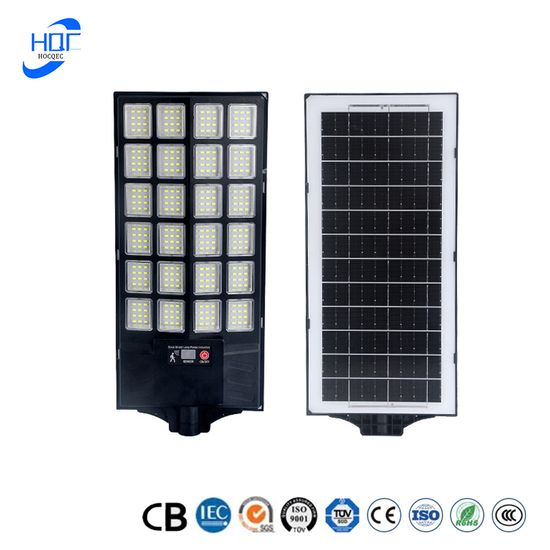


When selecting a 1000w solar street light, the '1000w' often refers to the LED equivalent brightness rather than actual power consumption. You must verify the Luminous Efficacy (lm/W); high-quality chips like Bridgelux or Philips should provide at least 150-180 lm/W. Additionally, check the Battery Capacity (Ah) and voltage. For a high-power light, a LiFePO4 (Lithium Iron Phosphate) battery with at least 3.2V/60Ah or 12.8V/20Ah is essential to ensure the light stays on throughout the night.
The core of a reliable solar light lies in three components: the Solar Panel, the Battery, and the Controller. Ensure the panel is Monocrystalline Silicon, which offers higher conversion efficiency (20%+) compared to polycrystalline. The controller should be an MPPT (Maximum Power Point Tracking) type rather than PWM, as MPPT increases charging efficiency by 20-30%, especially in cloudy conditions. Lastly, the housing should be Die-cast Aluminum with an IP65 or IP66 waterproof rating to withstand harsh outdoor environments.
For international trade, compliance is non-negotiable. Ensure the supplier provides CE, RoHS, and FCC certifications. For the batteries, UN38.3 and MSDS reports are mandatory for shipping safety. If the project is for government or municipal use, look for IES files (photometric data) to prove the light distribution meets road safety standards, and ISO 9001 factory certification to ensure consistent manufacturing quality.
Calculate the Total Cost of Ownership (TCO) by factoring in the lack of electricity bills and reduced wiring costs. While the initial purchase price might be higher than traditional lights, the zero-utility cost and minimal maintenance (usually just cleaning panels once a year) typically result in a payback period of 1.5 to 2 years. Prioritize suppliers on Made-in-China.com that offer a 3 to 5-year warranty to protect your investment.
The most common risk is capacity misrepresentation, where suppliers label a light as '1000w' but use a small battery that only lasts 3 hours. Always request a Full Load Test Report. Another risk is shipping damage to solar panels; ensure the supplier uses reinforced wooden crates or pallet packaging for bulk orders to prevent micro-cracks in the silicon cells.
Focus on the Battery Cycle Life and LED Chip Brand rather than just the price. Negotiate a staged payment plan (e.g., 30% deposit, 70% after inspection). For large orders, ask for 2% spare parts (controllers and remotes) to be included free of charge. Mention that you are sourcing via Made-in-China.com to leverage their Secured Trading services for payment protection.
Since these lights contain Lithium batteries, they are classified as Class 9 Dangerous Goods. You must ensure the supplier has the Certificate for Safe Transport of Chemical Goods. For shipping to the US or Europe, DDP (Delivered Duty Paid) terms are often preferred for smaller batches, while FOB (Free On Board) is more cost-effective for full containers where you can control the freight forwarder.